










Bijanis: from seed drill to candle holder

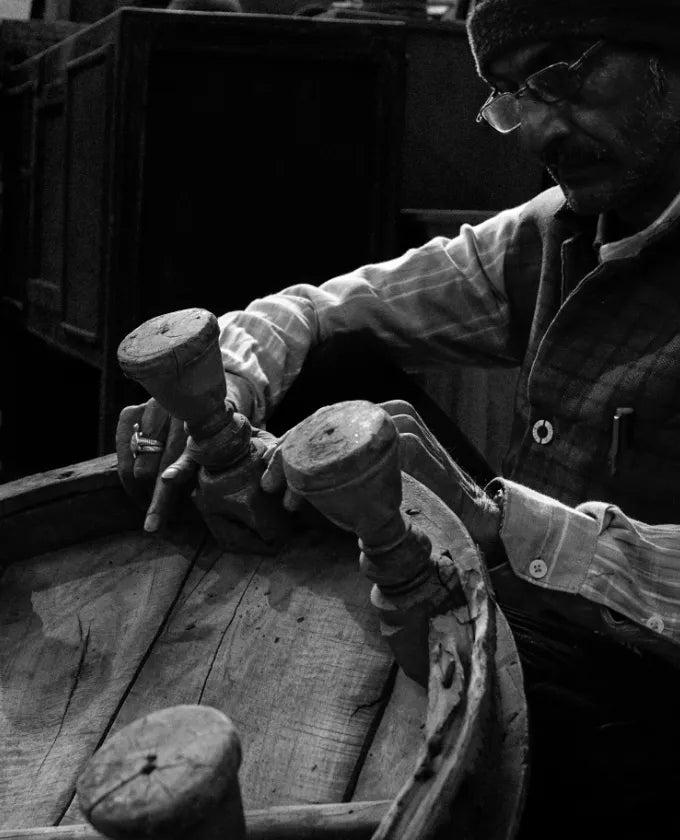
Bijanis were originally farming tools traditionally used to sow fields in India, a technique that was widespread in the 20th century. Hand-carved from solid wood, most often teak, they consist of a funnel at the top and several outlets at the bottom, so that several rows can be sown at once. Pipes connected to the outlets carried the seeds down into the soil.

Sowing a field is teamwork. One person handles the plough pulled by oxen, while the other pours the seeds into the bijani, which is fixed to the plough (see photo below). Among other things, this meant they did not have to bend down to drop the seeds into the furrow.

Photographer: Gene Graham. Photo taken in Madhya Pradesh in 1966. Source: bronzesofindia.com.

Sowing scene carved on a bijani.
The bijani takes its name from beej, which means seed in Hindi.
In India, many everyday objects are crafted like works of art, and woodworking is one of the country's many talents, so a great number of bijanis are fully carved. Geometric patterns, gods and goddesses, or animals such as elephants or sacred cows. Every piece is one of a kind.

Today, bijanis make perfect vintage decorative objects. They can be found as they are or turned into candle holders. Some people use them as candlesticks: in this case the bijani is turned upside down so that a long candle can be placed in each outlet. But most of the time, a metal cup is fixed inside the funnel to hold the candle. Whether in light or dark wood, they are perfect for decorating a shelf or a niche.

You can see our full collection of bijanis here.
Read more
In this article, I explain the true purpose of this must-have table in our bohemian interiors.

Some regions of India specialise in shawl weaving and have developed their own designs over the generations. More than 500 years ago, an old community of weavers is said to have migrated from Rajas...
Leave a comment
All comments are moderated before being published.
This site is protected by hCaptcha and the hCaptcha Privacy Policy and Terms of Service apply.