

Naga tables: from chief's bed to work of art
They are called “Naga tables”. The term is misleading.
These pieces of solid wood, with their raw and irregular shapes, were never designed as tables. In the hilltop villages of Nagaland, they served as beds: raised platforms on which members of the tribe slept, kept off the beaten-earth floors of their homes.
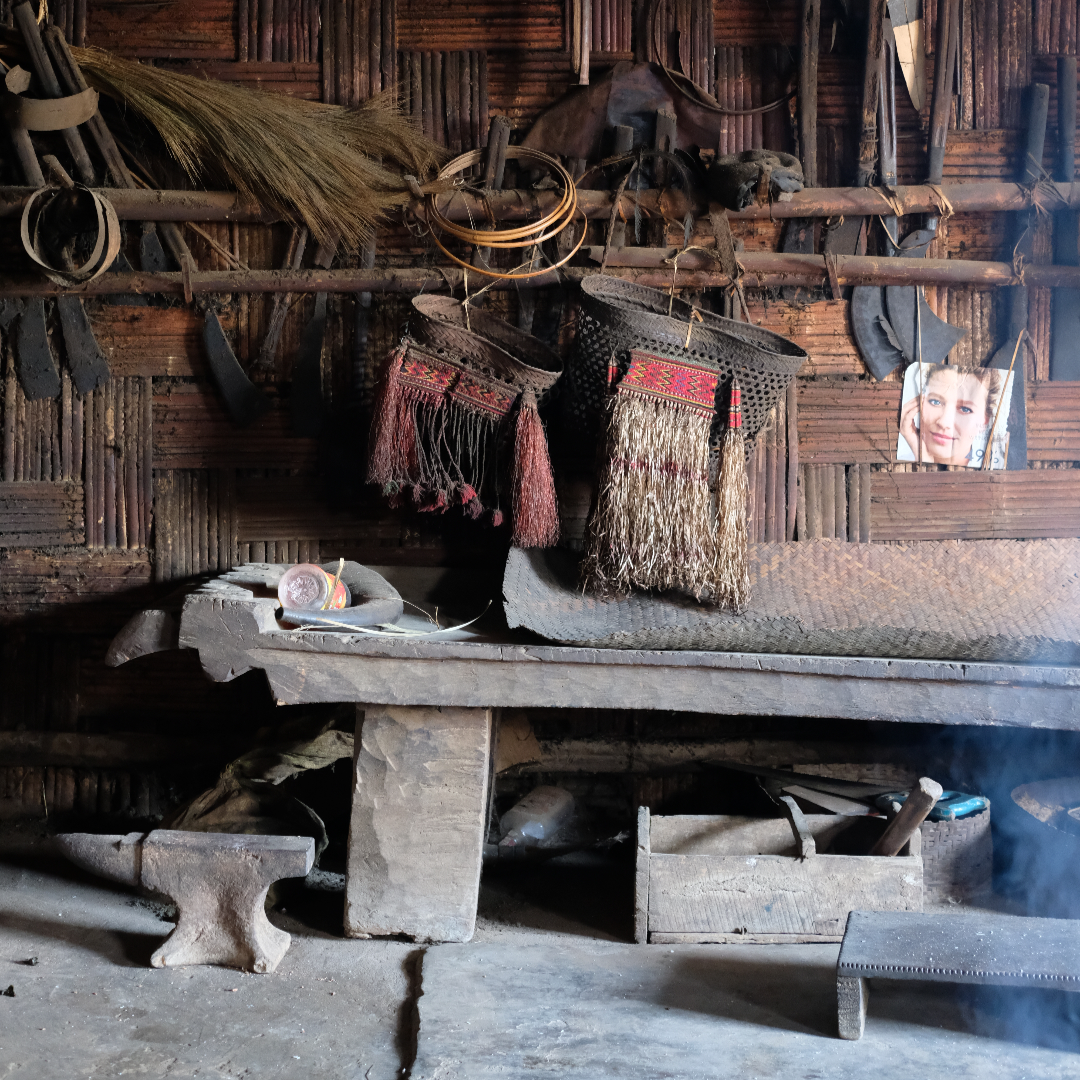
It was while travelling through Nagaland at the end of 2023 that we saw their original use with our own eyes. In the entrances of houses, in abandoned morungs, stacked one on top of another like relics of a bygone era. Their conversion into coffee tables is an accident of design history. But a happy accident.
A hill people, between two worlds
The Nagas are a group of Tibeto-Burman peoples divided into some fifteen main tribes (Konyak, Angami, Ao, Sema, Lotha, Chang, Phom, among others), settled in the remote hills of north-east India, on the Burmese border. These peoples were organised into independent villages, often in conflict with one another, and governed by a rigid patriarchal system in which the chief (the Angh among the Konyak) enjoyed an almost divine status.


Wood as a social language
Woodcarving held a central place in this society. It was not a matter of decoration: it was a language. The motifs carved on house doors, on the pillars of the morung and on façade panels told of the owner's social rank, his feats of arms, his lineage. Heads of mithun, a semi-wild bovine with imposing horns and a symbol of wealth and fertility, adorned the façades of chiefs' houses. The hornbill, a sacred bird, represented bravery and warrior youth; only the Angh had the right to wear its feathers on his headdress.
It is in this context that Naga tables must be understood. They are not simply utilitarian furniture. They are the product of a culture in which woodworking was an act charged with meaning.


Monoxylous carving: cut from a single block
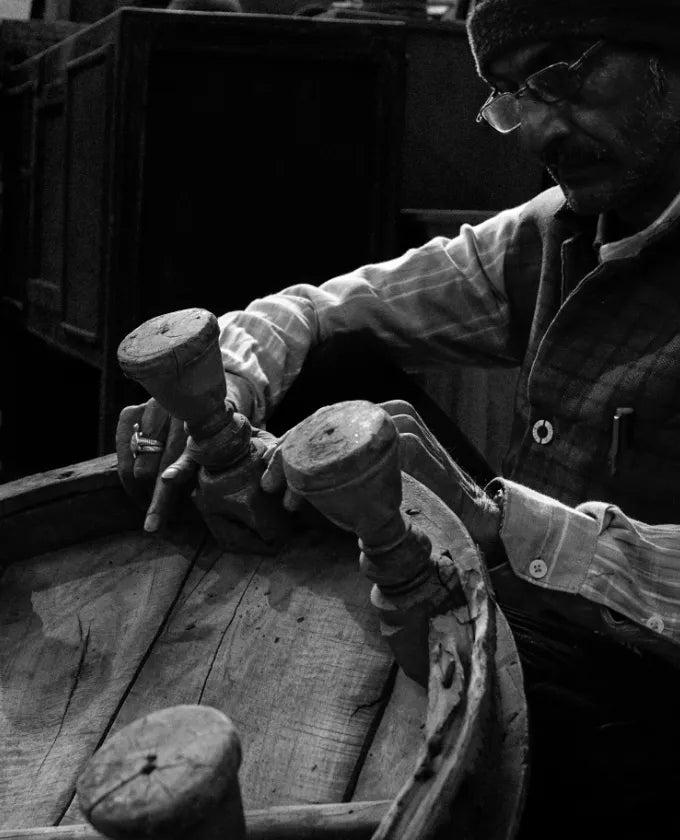
The most remarkable feature of an authentic Naga table is its monoxylous construction: legs and top are carved from one and the same piece of wood. No assembly, no joints, no screws. The carver started from a massive trunk and hollowed out the material by hand, using rudimentary tools: adzes, wood chisels and wrought-iron blades made by the village blacksmith.
This technique imposed considerable constraints. The size of the finished piece depended directly on the diameter of the available trunk. The longest pieces (some exceed two metres) required trees of exceptional girth. The wood used varied according to the species available locally: teak in the lowest valleys, tropical hardwoods in the hills. The hardness of the material, combined with the absence of mechanical tools, meant weeks of work for a single piece.
The result is an object of unfailing sturdiness. Unlike assembled furniture, which comes apart over time, a monoxylous table cannot be taken apart. This explains why pieces dating from the early 20th century, or even older, reach us today in a remarkable state of preservation.

The morung: dormitory, school and guard post
To understand what these beds were used for, you have to understand the morung. Every Naga village had at least one morung, a communal building serving as a dormitory for young unmarried men. The Ao called it ariju, the Konyak ban, the Angami kichuki, the Lotha champo. Each tribe had its own name, but the function remained the same.
The morung was much more than a simple dormitory. It was a school, a guard post and a social centre. There, young boys learned the customs of the tribe, the techniques of war, craftsmanship, song and dance. It was generally built on high ground, on the highest point of the village, to serve as a lookout in case of attack. Inside were hunting trophies, weapons and alarm drums carved from hollowed-out trunks. And the wooden beds on which the young warriors slept.
The finest pieces, the tallest and the most elaborately worked, went to the chief or to the most respected warriors. The height of the bed was no accident: it reflected rank. A top raised 30 or 40 centimetres signalled high status in the village hierarchy.
With the arrival of Baptist missionaries in the 19th century, then the abolition of headhunting and mass conversion to Christianity, the morung lost its purpose. The dormitories emptied. The beds remained.


Anatomy of a Naga table
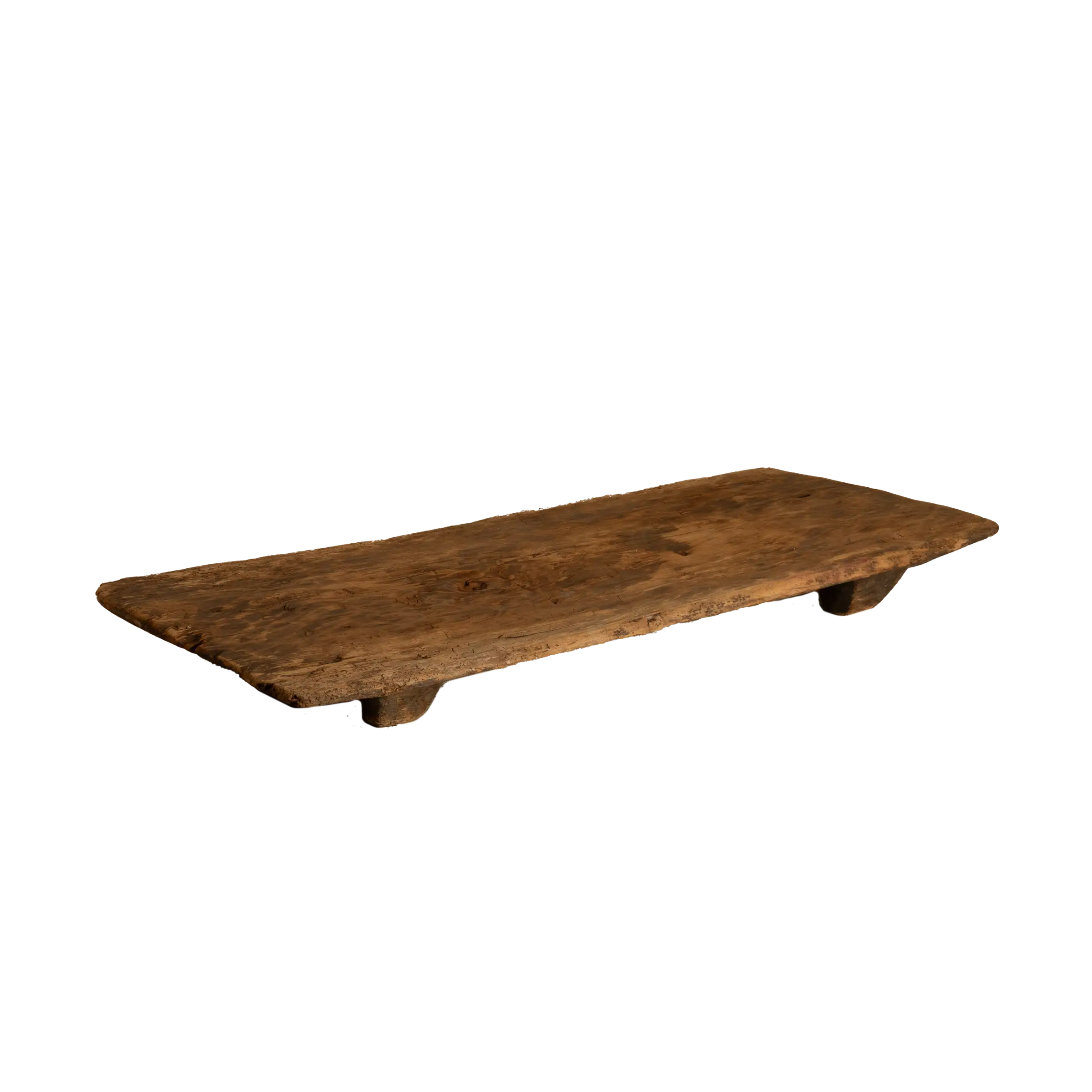
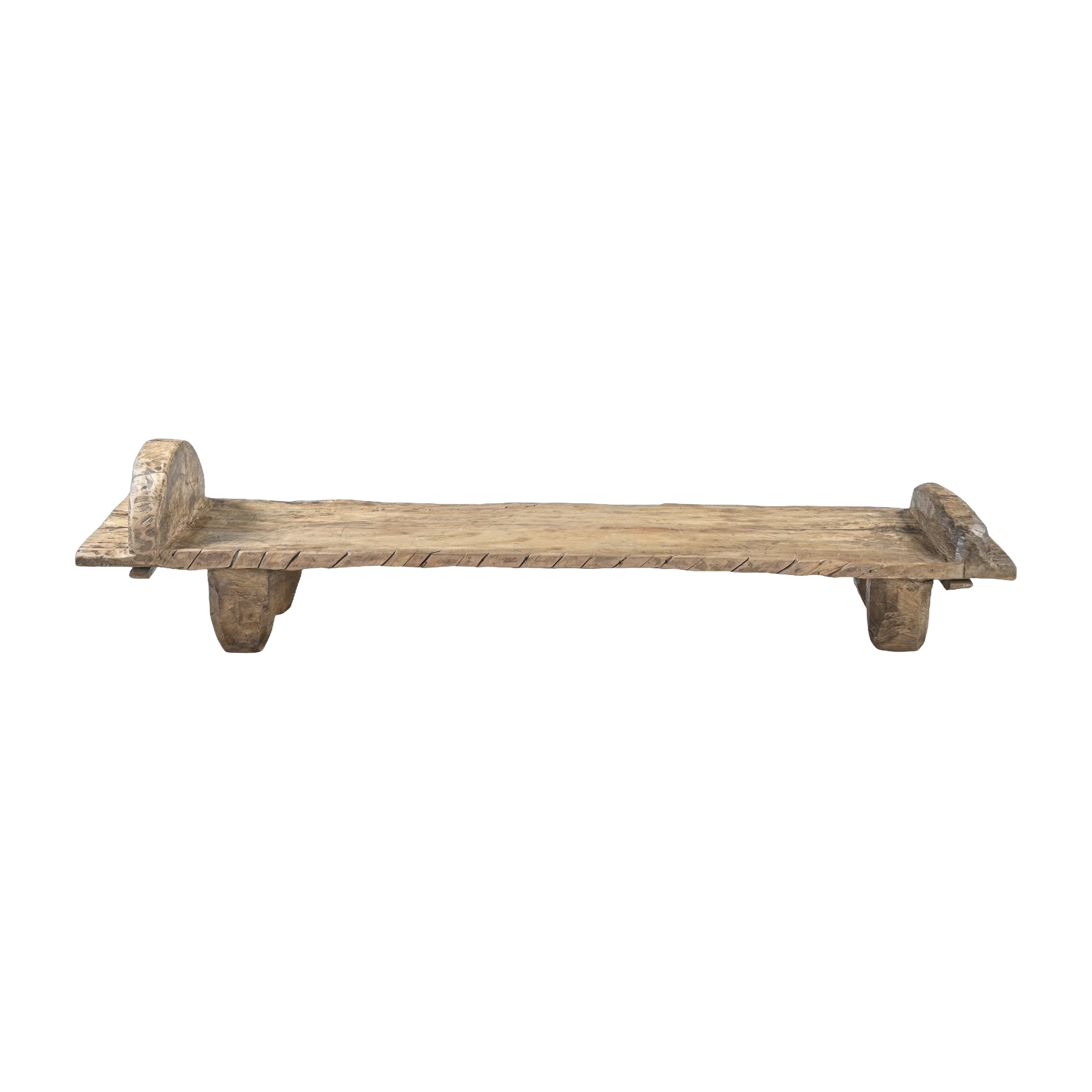
A typical Naga table consists of three elements, all from the same block:
The top: a flat or slightly concave surface, worn by decades of use. Tables that genuinely served as beds show a natural concavity in the centre, hollowed by the weight of the body over time. This wear is a mark of authenticity.
The legs: two or four, depending on the piece. The most common legs take a trapezoidal or arched form, ensuring stability on beaten-earth floors. Some rare pieces have single-block arched legs that replace separate legs with one continuous form. A particularly uncommon shape.
The headrests: on the oldest and most accomplished pieces, the ends of the top rise to form carved headrests. These may be straight, in an organic scroll, or decorated with geometric motifs. Their presence confirms the original function as a bed.
Dimensions vary but generally correspond to the height of an adult. The smallest pieces usually measure no less than 1.70m; the largest exceed 2.30m. The height, which ranges from 15 to 50 centimetres, was historically the most important marker of status. Low pieces (15-22 cm) were the most common; tall pieces (28 cm and more) signalled high rank.


The signs that never lie
What distinguishes an old Naga table from a reproduction is the patina. The wood, exposed for decades to smoke from the hearth, cooking grease and the elements, develops a surface of a depth that only time can produce. Some pieces reach an almost lacquered black. A shade that is neither painted nor applied, but the result of successive layers of soot and handling.
The carver's chisel marks remain visible on authentic pieces, unlike mechanically sanded reproductions. Drying cracks, chips and surface irregularities are not defects: they are the marks of a previous life.
Finally, in winter the Nagas kept warm with white-hot stones placed under their beds. This is why the underside of some Naga beds has been blackened by the heat, a mark of authenticity.

A fragment of memory
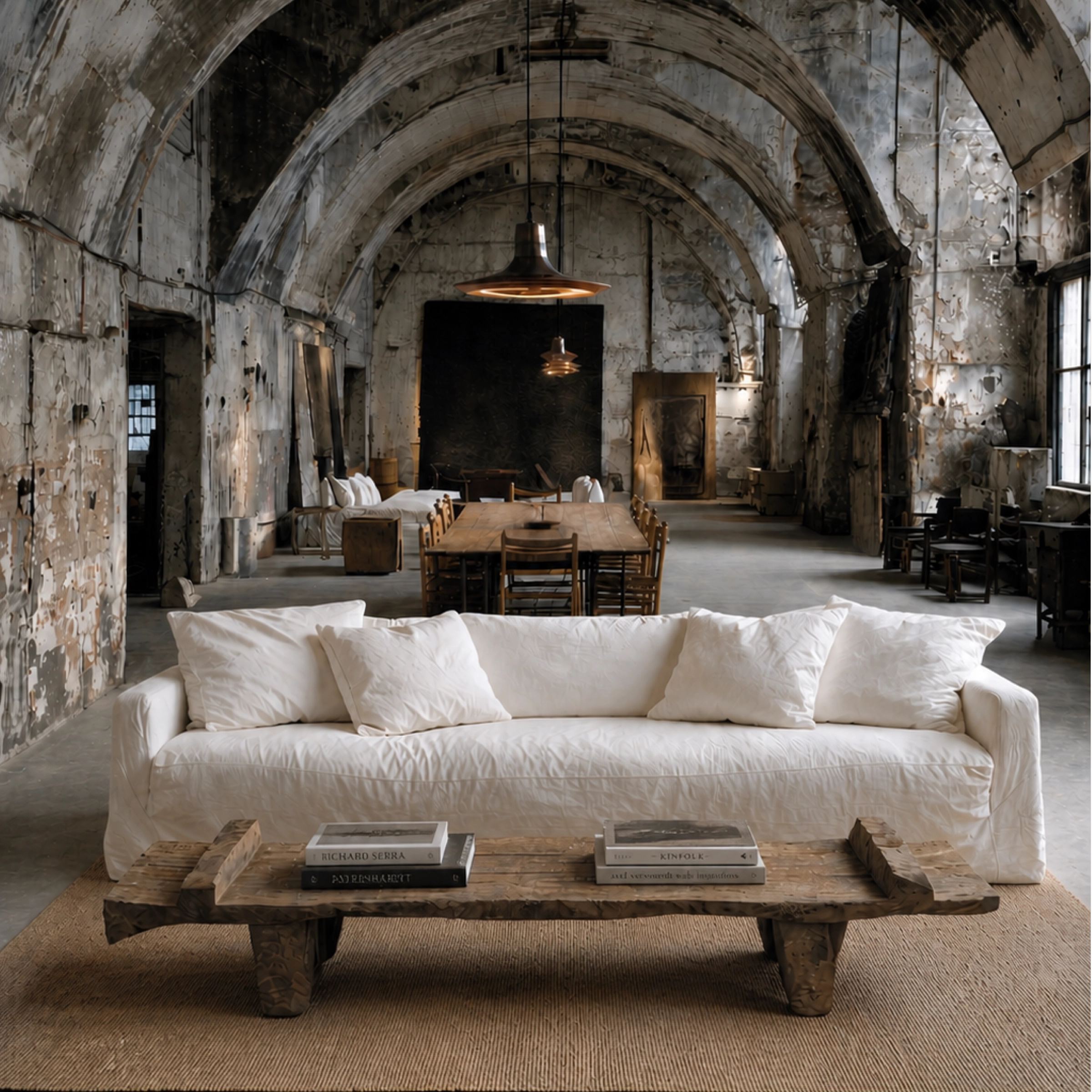
Naga tables fit naturally into wabi-sabi, the Japanese aesthetic that values imperfection, wear and the beauty of things that bear the traces of time. Their raw wood, irregular shapes and complete absence of symmetry answer the desire for a return to essentials that characterises contemporary interior design.
But it would be reductive to confine them to a trend. These objects carry within them the history of a people, of a vanished craft, of a world that no longer exists. The last tattooed warriors of Nagaland, those who knew the morung in its original function, are now over 85 years old. With them disappears the living memory of these pieces.
Placing a Naga table in your living room means welcoming a fragment of that memory.


Leave a comment
All comments are moderated before being published.
This site is protected by hCaptcha and the hCaptcha Privacy Policy and Terms of Service apply.