

Daraaj, our Indian apothecary cabinet from Gujarat: translation and explanation of its 56 drawers
Drawer 1
ભીલામા (Bhilama / Malacca Nut). Bhilama, also known as Malacca nut, is a common spice in Indian cooking. It has a mild, spicy flavour and is often used in pickles (fermented condiments), chutneys and curries.
Drawer 6
ગુલાલ (Gulal). Gulal is a pink powder used in religious ceremonies. It is often used to colour the clothes and bodies of the participants. Coloured powders such as Gulal were once made from flowers, but the discovery of synthetic colours gradually replaced powders of natural origin.
Drawer 14
કડીયો ગુંદર (Kadiyo Gundar) is gum tragacanth, used in Ayurvedic medicine for its medicinal properties. It is also used as a food thickener and in sweet making. It comes from the sap of certain plants of south-west Asia.
Drawer 19
સિંધુર (Sindhoor), also known as Sindoor, is an orange powder used in religious ceremonies in India.
Drawer 21
આંબા હળદર (Amba Haldar) Also known as Haldi, or turmeric in English, it is a plant of the ginger family used in cooking (white turmeric: Amba, orange turmeric: Haldar) as well as in Ayurvedic medicine for its antioxidant and anti-inflammatory properties.
Drawer 34
કંકુ (Kanku) or "Kumkum", a red powder used in religious ceremonies. This powder is similar to "Abil", "Gulal" and "Sindoor", differing only in its red colour.
Drawer 46
ગોપી ચંદન (Gopi Chandan) - This substance is used for the "Tilak", a coloured mark on the forehead worn by devotees of Lord Krishna. Gopi Chandan is a clay found near Gopi Lake in Dwarka, and its yellowish colour makes it a unique and highly prized substance.
Drawer 54
ચાક ખડી (Chak Khadi): This chalk mineral salt, composed mainly of calcite, has many uses in Ayurvedic as well as modern medicine, in the cement industry, in coloured pencils, etc. In India, this soft white mineral is only found in Gujarat: in Amreli, Porbandar and Rajkot.
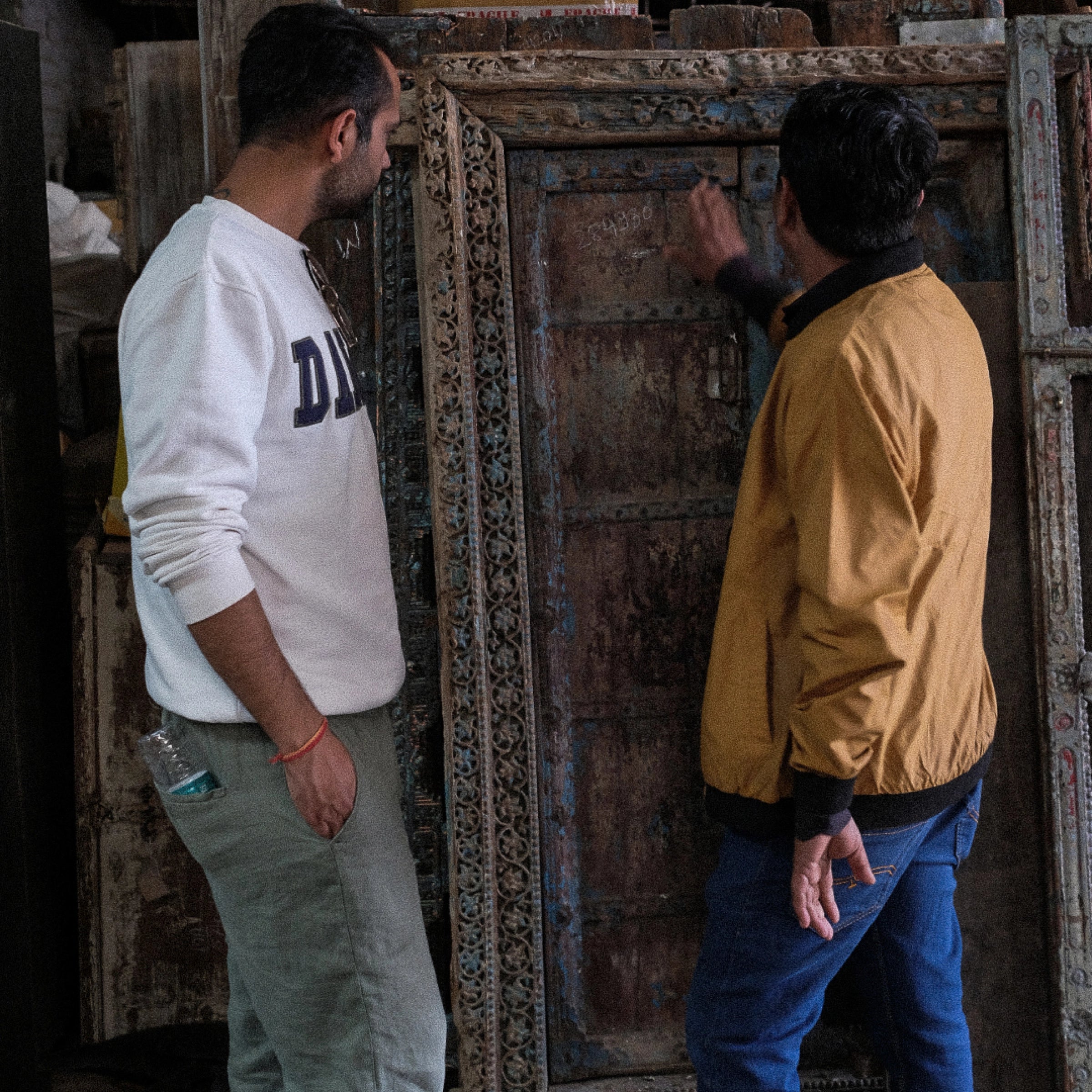
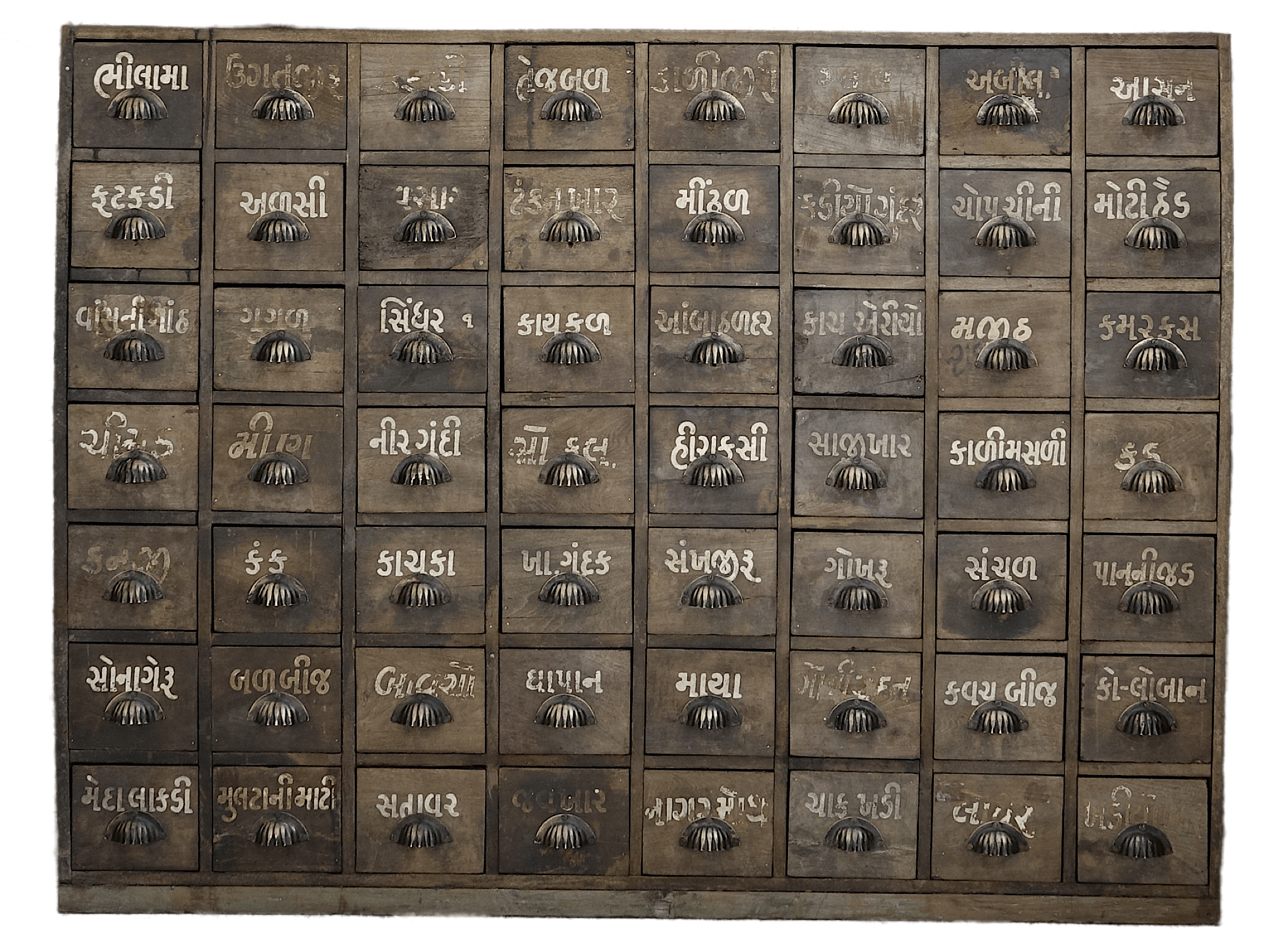
During our last trip to India in February, we came across a pair of apothecary cabinets in very good condition, from the same shop or workshop. Each drawer is marked with a painted inscription, probably indicating the plant or substance that was stored in it.
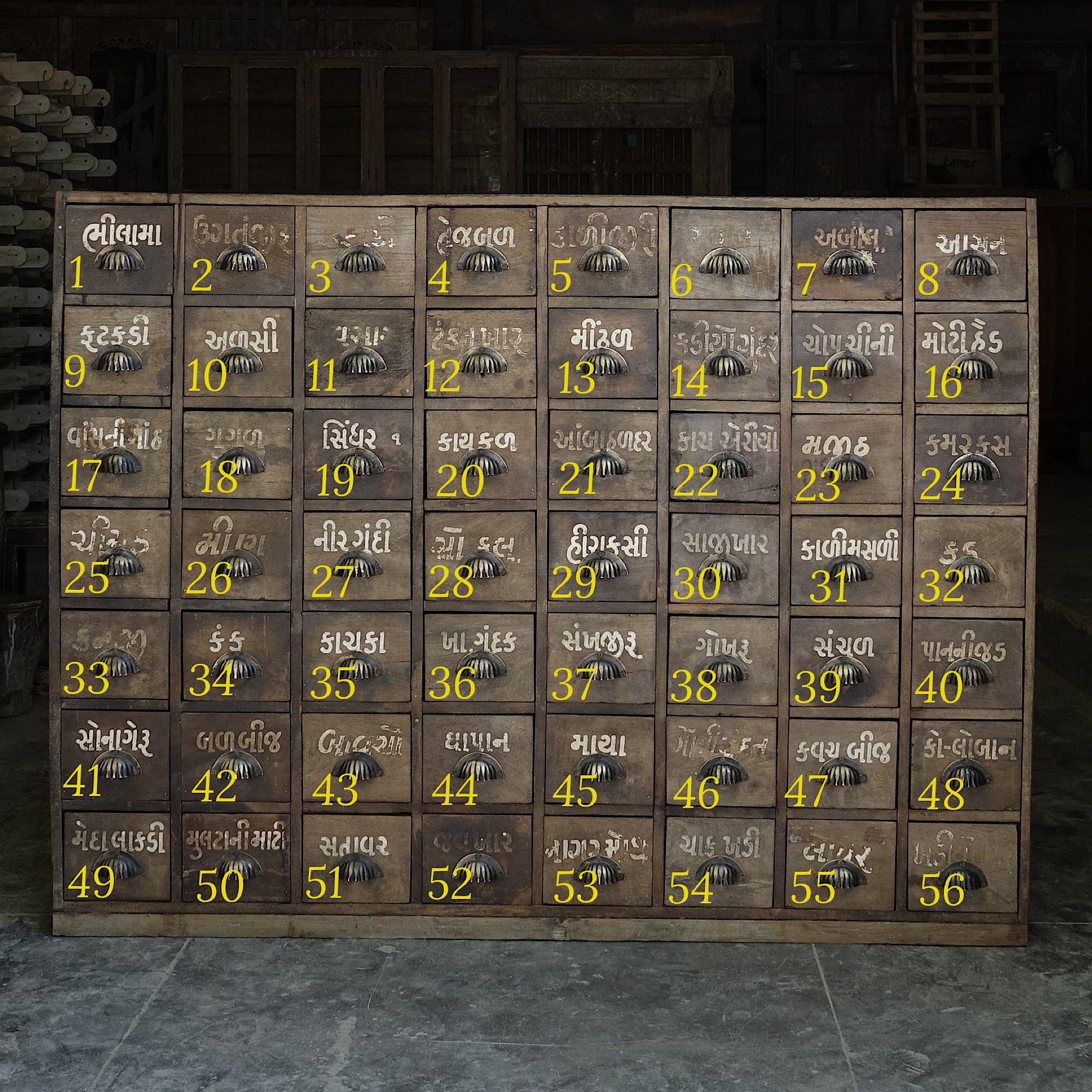
We did not know straight away which goods these cabinets had once held in their drawers, as I can neither read nor speak what we later identified as Gujarati. I was nevertheless able to decipher some inscriptions quickly, such as drawer No. 27, which reads "sindoor", since the spelling in Gujarati and Hindi is similar. From then on, we knew that we were dealing with a cabinet that had been used in a shop rather than in a workshop.
I then asked a friend from Gujarat to translate each of the 56 drawers for me. This friend told me that in their grandparents' day, it was common for the people who owned this kind of cabinet to be called "Sarvaiya": sellers of Ayurvedic medicine and of other plants and spices with health benefits or used in Indian cooking. My friend, who is approaching thirty, was in fact unable to translate all the drawers and had to ask their grandparents or neighbours, as some of the inscriptions/goods are probably no longer used today.
We are therefore now certain that these are indeed authentic apothecary cabinets. They can probably be dated to the first half of the 20th century. Cabinets of this kind are no longer found in situ today, having been replaced by more modern and less expensive alternatives. Indeed, it is worth mentioning that this cabinet is made of solid teak, both the frame and the drawers, and such a large number of drawers would be costly in wood today.
In the translation presented below, we can see that the drawers of this apothecary cabinet were filled with various herbs and spices. Some drawers have even kept the colour or smell of the goods they once stored. In the following lines, we present, drawer by drawer, the Gujarati inscription and its translation into Hindi (where available), English and French. We also give some explanation of the use and effects of each plant.

Each numbered drawer in the photo above corresponds to its caption below:
-
ભીલામા (Bhilama / Malacca Nut). Bhilama, also known as Malacca nut, is a common spice in Indian cooking. It has a mild, spicy flavour and is often used in pickles (fermented condiments), chutneys and curries.
-
ઉગતંજીરુ (Ugatmjeeru / Cumin Seed) Cumin seeds, also called Ugatmjeeru in Gujarati, are a popular spice used in Indian cooking for their strong, aromatic flavour. They are often used in curries, rice dishes and Indian breads.
-
કંકોડી (Kankodi - Spine gourd). Kankodi, also called spine gourd, is both a vegetable used in cooking and a major Ayurvedic plant. It is known for its medicinal properties and is often used to treat digestive problems.
-
તેજબળ (Tejbad / Toothache tree). The toothache tree, called Tejbad in Gujarati, is aptly named, as it is used in Ayurvedic medicine to treat dental pain. It is also used as a spice in Indian cooking for its strong, spicy taste.
-
કાળીજીરી (Kadijiri / black cumin). Black cumin, also called Kadijiri in Gujarati, is a spice used in Ayurvedic medicine for its medicinal properties. It is often used to treat digestive problems and to strengthen the immune system.
-
ગુલાલ (Gulal). Gulal is a pink powder used in religious ceremonies. It is often used to colour the clothes and bodies of the participants. In the past, coloured powders such as Gulal were made from flowers, but the discovery of synthetic colours gradually replaced powders of natural origin.

-
અબીલ (Abil). Abil is a white powder used in religious ceremonies. It is often used to colour the clothes and bodies of the participants.
-
આસન (Asan). Asan is a decorative cloth on which people sit during religious ceremonies. It is often used to create a peaceful, contemplative atmosphere.
-
ફટકડી (Fatakdi). This word has no Hindi translation. It is a substance called alum, used in Ayurvedic medicine.
-
અળસી (Adasi). Adasi means linseed. Linseed is eaten as a snack after lunch or dinner and also has a medicinal use.
-
Unfortunately, the inscription is not legible.
-
ટંકણખાર (Tankan khar). This is borax, a substance sometimes used as a preservative in jars of pickles (fermented condiments) and also used in Ayurveda.
-
મીંઢળ (Mindhod). The common name in Hindi is Mandan Phal, which translates into English as "mountain pomegranate" (grenade des montagnes in French). It is an important Ayurvedic plant and is also used in certain religious practices.
-
કડીયો ગુંદર (Kadiyo Gundar) is gum tragacanth, used in Ayurvedic medicine for its medicinal properties. It is also used as a food thickener and in sweet making. It comes from the sap of certain plants of south-west Asia.
-
ચોપ ચીની (Chop Chini) is a medicinal plant known as "China root". It is used in Ayurvedic medicine to treat digestive problems and inflammation.
-
મોટી હૈડ (Moti Haid). Unknown substance.
-
વાંસ ની ગાંઠ (Vansh ni Ganth) is a bamboo node used in Ayurvedic medicine for its medicinal properties. It is also used as an ingredient in certain dishes.
-
ગુગળ (Gugad), also called Gugul, is a tree of the Burseraceae family used in incense sticks as well as in Ayurvedic medicine to treat various ailments, notably joint disorders and cholesterol.
-
સિંધુર (Sindhoor), also known as Sindoor, is an orange powder used in religious ceremonies in India.
-
કાયકળ (Kaykad), also called Kajjali, is an Ayurvedic preparation made from sulphur and mercury, used to treat skin diseases.
-
આંબા હળદર (Amba Haldar) Also known as Haldi, or turmeric in English, it is a plant of the ginger family used in cooking (white turmeric: Amba, orange turmeric: Haldar) as well as in Ayurvedic medicine for its antioxidant and anti-inflammatory properties.
-
કાચ એરીયો (Kach Ariyo). Unknown substance.
-
મજીઠ (Majith) is also known as Indian madder. It is a plant used in Ayurvedic medicine for its anti-inflammatory properties and to treat skin diseases.
-
કમરકસ (Kamarkas). Also called Palash gum, this substance is extracted from the Salvia Plebeian plant. It is an ingredient commonly used in Ayurveda for its healing properties, particularly to treat gastrointestinal problems.

-
ચિમેડ* (Chimed), also known as Chakanu or Cassia absus Linn, is used in Ayurvedic medicine for its diuretic, laxative and astringent properties. It is also used to treat skin disorders, joint pain and respiratory diseases.
-
મીણ (Min), also called moum, is a waxy substance used in several fields, notably Ayurvedic medicine, decoration and pottery.
-
નીર ગુંદી (Nir Gundi), also known as Vitex negundo, is a plant used in Ayurveda to treat a variety of ailments, including digestive problems, joint pain and respiratory infections.
-
સોફલાવાર (Safflower, also called Kasumbo in Gujarati). Safflower is a plant with many applications, notably in Ayurvedic medicine, in dyeing and during the Holi festival, and it holds great cultural importance. Its properties are close to those of saffron.
-
હીરાકસી (Hirakashi). This is ferrous sulphate, which has many uses, such as Ayurvedic medicine, ink making (Shyahi), fabric dyeing and as a disinfectant.
-
સાજીખાર (Sajikhar). This is sodium carbonate (soda), which has many uses, such as Ayurvedic medicine, soap making and occasionally cooking (more rarely). This compound is extracted naturally rather than produced industrially: it is obtained by burning a type of flower.
-
કાળી મૂસળી (Kali Musali), or Curculigo orchioides. This plant is used in Ayurveda to improve sexual function, fertility and blood circulation.
-
કડુ (Kadu), or Picrorhiza kurroa. This plant is used in Ayurveda to treat liver disorders, respiratory infections and autoimmune diseases.
-
The name on the following image is not legible
-
કંકુ (Kanku) or "Kumkum", a red powder used in religious ceremonies. This powder is similar to "Abil", "Gulal" and "Sindoor", differing only in its red colour.
-
કાચુકા (Kachuka) or "Imli ke Bij": tamarind seeds, which are used in Ayurveda to treat constipation, digestive disorders and heart disease.
-
Unfortunately, the inscription is not legible.
-
શંખજીરું (Sankh Jeeru). Caraway: this spice is widely used in Indian cooking, but it is also used in Ayurvedic medicine for its digestive properties and to treat respiratory problems. Caraway is also used in aromatherapy for its calming and anti-inflammatory properties.
-
ગોખરુ (Gokhru): this is Tribulus terrestris, a plant used in Ayurvedic medicine.
-
સંચળ (Sanchad, also called Kala Namak in Gujarati): this is rock salt, used in cooking and in Ayurvedic medicine.
-
પાનની જડ (Pan ni Jad) is a plant whose roots are used; its name literally means "roots of the betel leaf". It is used in Ayurvedic medicine and is also an important spice, although it is rare nowadays.
-
સોનાગેરુ (Sona Geru) is a dark yellow ochre pigment, used in Ayurvedic medicine as well as in pottery. It is still used today to make rangolis, the ephemeral designs drawn on the ground with coloured powders.
-
બળબીજ (Bad Bij), or Kharaiti, is a plant whose fibres are stronger than jute and were therefore used in the past. The plant is also used in Ayurvedic medicine, while its stem was used to make brooms.
-
બાવચો (Bavcho), or Somraj, is a plant used in Ayurvedic medicine.
-
ઘાપાન (Ghapan). Also known as Vilayati Ketki, it is a plant used in Ayurvedic medicine as well as in cooking, where it serves as a sweetening additive. It is native to the Americas and is now grown all over the world.
-
માચા (Macha) - This plant is similar to Bathua Bhaji and is also known as "Salt Bush". It is rich in protein and is often used in cooking. It grows near the sea.
-
ગોપી ચંદન (Gopi Chandan) - This substance is used for the "Tilak", a coloured mark on the forehead worn by devotees of Lord Krishna. Gopi Chandan is a clay found near Gopi Lake in Dwarka, and its yellowish colour makes it a unique and highly prized substance.
-
કવચ બીજ (Kavach Bij) - Mucuna Pruriens seeds are used in Ayurvedic medicine for their beneficial properties for the nervous system. They are also known as Kaunch ke Bij.
-
કો-લોબાન (Co-Loban) - This resin is often used in Ayurvedic medicine, as well as an air freshener and in incense making. It is extracted from Styrax Benzoin.
-
મે દા લાકડી (Meda Lakdi). This plant is used in Ayurvedic medicine for its anti-inflammatory properties. It is also known as Maida Lakdi and is extracted from Litsea Glutinosa.
-
મુલતાની માટી (Multani Mati). This Fuller's earth (also called Multani clay) is still widely used as a natural skincare routine (my Gujarati friend and their family use it regularly). Originally, it was the clay available in the Multan region (now in Pakistan), which had unique properties for achieving beautiful skin naturally.
-
સતાવર (Shatavar). Asparagus racemosus (shatavari) is a common species of asparagus. It is used in Ayurvedic medicine. The roots are used as a vegetable, and its white sap is used to make "Murabba", an Ayurvedic medicine.
-
જવખાર (Jav khar): Potassium salts (mainly potassium carbonate) are used in Ayurvedic medicine.
-
નાગરમોથ (Nagar Moth): Cyperus rotundus is used in Ayurvedic medicine.
-
ચાક ખડી (Chak Khadi): This chalk mineral salt, mainly composed of calcite, has many uses in Ayurvedic medicine as well as in modern medicine, the cement industry, coloured pencils and more. In India, this soft white mineral is only found in Gujarat: in Amreli, Porbandar and Rajkot.
-
લોધર (Lodhar or Lodhra). Symplocos racemosa is used in Ayurvedic medicine. Lodhra is a tree native to India whose bark is used in Ayurvedic medicine to treat various problems such as excessive bleeding, haemorrhoids, ulcers and skin diseases. It is also used in hair care to reduce dandruff and stimulate hair growth.
-
ખડિયો ખાર (Khadiyo Khar) is a type of edible salt similar to rock salt, but from different regions.
If you have made it to the end, congratulations. For those who could not read it all, here is the summary: this cabinet held many spices and plants used in Indian Ayurvedic medicine and cooking. It also held powders and pastes used in religious ceremonies. Some substances, seeds and plants are still used today, while others have fallen out of common use. This cabinet is a remarkable witness to the medicinal practices of Gujarat in the early 20th century, or even earlier...
Of course, as always, we welcome comments and corrections to our article. Do feel free to share your thoughts. And see you soon for the translation of the second apothecary cabinet...
Ankush
Read more

Some regions of India specialise in shawl weaving and have developed their own designs over the generations. More than 500 years ago, an old community of weavers is said to have migrated from Rajas...
Phurbas are ritual daggers associated with deities of Vajrayana Buddhism. Made up of a blade, a handle and a pommel, these carved daggers are often made of brass and metal, but also of wood, as he...
1 comment
Bonjour
Je suis très intéressée par le meuble d aphoticaire.
Je voudrais savoir le prix ?
Merci pour votre réponse
Valérie
grillet
Leave a comment
All comments are moderated before being published.
This site is protected by hCaptcha and the hCaptcha Privacy Policy and Terms of Service apply.